The gap between how enterprises want to adopt AI and how they actually implement it remains one of the most consequential leadership challenges in 2026. While 82% of enterprise employees use generative AI at least weekly, only 53% of employees trust their leaders to implement AI effectively—suggesting most organisations have the tools but lack the leadership framework to wield them. This measurement paradox reveals the core tension that defines the current moment.
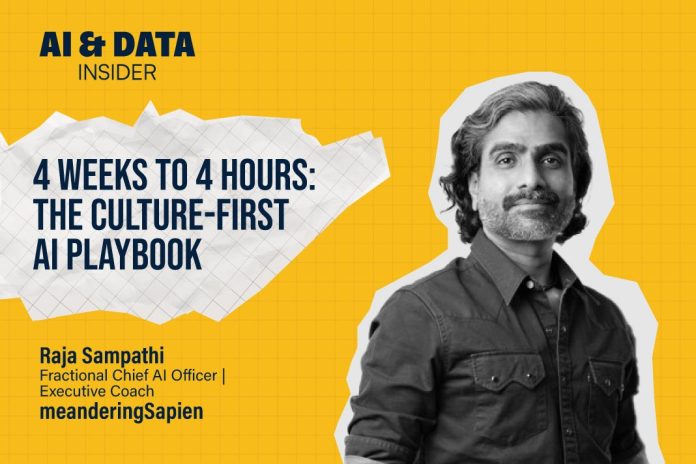
Enter Raja Sampathi, a fractional chief AI officer and executive coach whose philosophy directly challenges how organisations approach technology adoption. Operating through meanderingSapien while intentionally capping his portfolio to just four clients annually, Sampathi diagnoses the problem not as a technology gap, but as a leadership gap rooted in a single, overlooked insight: AI amplifies your existing culture; it doesn’t fix it.
This means a legacy-process company using AI remains a legacy-process company—just faster. An innovation-culture company becomes exponentially more dangerous to competitors. Sampathi warns that AI will accelerate bad strategy just as readily as good strategy, making cultural prerequisites non-negotiable.
His approach to transforming skeptics into champions is equally pragmatic. Rather than dismissing leadership hesitation about AI accuracy and reputation risk as irrational, he repositions subject matter experts as the “human in the loop”—tasked with verification rather than generation.
Perhaps most notably, Sampathi is positioning himself ahead of a market inflection happening in real-time: AI-powered mental health support. The global chatbots-for-mental-health market is projected to reach $2.15 billion in 2026 and expand to $7.57 billion by 2035. Sampathi has personally built his own therapy bot and describes it as “insanely useful” when facing anxiety at midnight without access to a licensed therapist. He’s careful with scope—the bot isn’t a substitute for professional therapy—but the accessibility argument is unassailable: millions currently get no support because therapy is out of reach.
This positions 2026 as a critical moment where corporate AI adoption and deeply personal AI usage converge, requiring a different leadership posture entirely: one that treats AI with reverence because of its capacity to create harm, while leveraging it to solve access problems that traditional systems have failed to address.
The conversation has been edited for length and clarity.
You emphasise that the next generation of leaders won’t just drive ROI from AI adoption—they’ll evolve alongside it. What key metrics do you use when evaluating true AI ROI in enterprises, beyond the usual cost savings or productivity gains?
Cost savings and productivity gains get a bad rep. I truly believe they are the first step in helping people realize the value of AI, and the time gained from productivity is what goes into innovation. That should be Phase 1—and it’s okay for companies to extract significant value from Phase 1, especially large enterprises.
Phase 2 is innovation: new products and services powered by workflows that wouldn’t have been possible without AI. This drives my favorite metrics—higher revenue per employee, capital efficiency, and enterprise valuation.
From your work as a Fractional Chief AI Officer and executive coach, what does it take to move leaders from AI skepticism or resistance to true AI ‘championship’? Can you share a practical case where a leadership mindset—or a single coaching moment—unblocked measurable business value?
For an executive, skepticism usually stems from a specific fear: “If the model makes things up, my reputation is on the line.”
I had a client—a deep subject matter expert—who refused to use AI because he didn’t trust the accuracy. I told him:
“Good. The resistance comes from your expertise. You are the only one qualified to call ‘BS’ on the output, so use it to verify, not just create.”
Once he realised he was the “human in the loop,” he felt safe. He used AI to complete a complex research project in 4 hours that previously took his team 4 weeks. That’s how you turn a skeptic into a champion: prove the speed, but respect their expertise.
ALSO READ: Why Frontline Knowledge Beats AI Expertise: Rethinking Enterprise AI Talent
Many companies send out ‘use AI’ memos, but you advocate that leaders must model adoption themselves. What are some tangible ways business or tech leaders can normalise and scale AI behavior change across their organisations?
The reason leaders must model adoption themselves is that AI is unlike an ERP system—it can think and adapt. Most importantly, given enough autonomy, it can make decisions on your behalf, which is why you should treat this technology with reverence. And this is why leaders must stay on top of AI: a bad decision can wipe millions off a balance sheet in seconds.
I advise leaders to operate on two fronts: “Play” and “Protect.”
Play: Show people how you use AI—at work and outside. If you’re planning a vacation using AI, share your prompts. Be open about what’s not working in AI projects. Communication is key.
Protect: Policy and governance. Traditionally, policy belonged to HR or IT. But when tools like Grok allow for the creation of non-consensual synthetic images, that’s a CEO-level risk. A modern AI policy must explicitly state that using generative AI to harass colleagues results in immediate termination. That level of clarity has to come from the top.
Too many AI programs stop at automating legacy processes. How can businesses break through this barrier?
Readers might not like this answer: AI amplifies your existing culture. It doesn’t fix it.
The reason programs stop at “automating legacy processes” is that the company lacks a culture of innovation. You can’t just “install” AI and expect creativity if you didn’t have it before.
If you have two companies making coffee cups, the one with a culture of innovation uses AI to understand consumer trends and generate new designs. The stagnant company just uses AI to write emails about coffee cups faster.
If you’re truly committed to getting the most value out of AI, you have to be willing to change. You have to be willing to experiment. You have to overcome the fear of failure. You’ve got to take your chances. This is strategy 101.
Warning: AI will accelerate bad strategy too.
As a builder of applied AI solutions—including unique NLP and conversational systems—what’s your take on the industry’s rush toward ‘prompt engineering’ versus designing systems for context, quality, and true collaboration between human and AI? Any lessons from your work on therapy bots or specialised copilots?
Prompts are still important while working with LLMs; however, applied AI solutions are about use cases, workflows, and leveraging subject matter expert knowledge.
On therapy bots specifically: I believe AI therapy will be one of the biggest drivers of adoption in 2026.
Therapy is currently a luxury good. It’s outrageously expensive and scarce. AI democratises that access. While we need strict safety guardrails, the ability to provide mental health support to the millions who currently get nothing is a massive net positive for society.
I’m not a qualified therapist, but I have enough personal experience in this field that I built my own therapy bot. I can’t tell you how insanely useful it’s been when I know I can’t call someone at midnight.
ALSO READ: What Everyone Got Wrong About AI in 2025