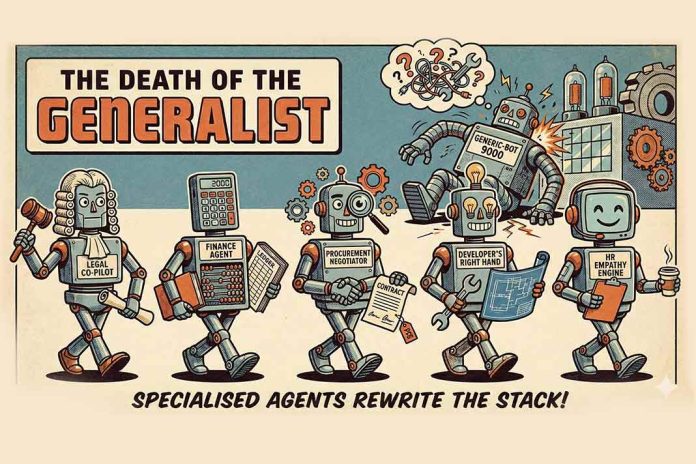
For the last two years, the enterprise strategy was simple: procure the large, generic AI licence for everyone. It was the digital equivalent of giving every employee a Swiss Army Knife and asking them to build a house. While you technically have a blade and a screwdriver, framing a wall requires tools designed for the job.
We are now entering the phase of the “Specialised Agent”.
The initial appeal of generic Large Language Models (LLMs)—their ability to converse fluently on topics ranging from 17th-century poetry to Python code—is precisely their limitation in the enterprise. When a CFO poses a query, they do not require a creative response; they require a GAAP-compliant one. When a General Counsel reviews a contract, “mostly correct” is simply not an option.
We scoured the market for the specialised copilots that are replacing generic seats. These tools do not merely generate text; they understand the specific ontology, risk profiles, and workflows of their vertical.
Here are the five specialised copilots currently outperforming the generalists.
1. The Legal Specialist: Harvey
The Problem: Generic models often treat a legal contract like a blog post—a mere collection of words. They frequently miss the subtle interplay of clauses, precedents, and jurisdictional nuance that defines legal risk.
The Specialist: Harvey (or Spellbook)
Why it Wins: These copilots function less like a writer and more like a senior associate. They can redline documents against your specific company playbooks, spotting potential risks in indemnity clauses that a general model might overlook. They do not just summarise case law; they synthesise it to build an argument. In a field where a single hallucinated citation can compromise a case, the specialist is non-negotiable.
2. The Finance “CFO” Agent: BlackLine / ChatFin
The Problem: LLMs can struggle with complex arithmetic and logic chains. Asking a generic chatbot to analyse your Q3 spend can result in confident, yet mathematically unsound, outputs.
The Specialist: BlackLine or ChatFin
Why it Wins: These tools do not rely on the LLM to perform the calculation; they use the LLM to retrieve the data from your ERP (such as Oracle or NetSuite) and then run deterministic scripts to analyse it. They specialise in “anomaly detection”—identifying that one irregular transaction in a sea of thousands that a human auditor might miss. They offer what finance craves most: audit trails rather than creative interpretation.
ALSO READ: How AI is Elevating the Human Loan Officer Experience
3. The Procurement Shark: Fairmarkit / Globality
The Problem: Procurement teams often spend 80% of their time on 20% of the spend (the strategic contracts). The “tail spend”—purchasing laptops, janitorial services, software licences—often goes unmanaged because human intervention is too costly for smaller orders.
The Specialist: Fairmarkit or Globality
Why it Wins: This constitutes “Autonomous Negotiation”. These copilots can independently email hundreds of vendors, solicit quotes, and negotiate pricing based on historical data benchmarks. They do not just suggest a supplier; they manage the commercial conversation. It is a pure ROI play that generic chatbots simply cannot execute.
4. The Developer’s Right Hand: GitHub Copilot Enterprise
The Problem: This is the most mature category, but the distinction remains vital. A generic chat window can be a friction point for a coder who must copy-paste code back and forth between windows.
The Specialist: GitHub Copilot Enterprise (or Cursor)
Why it Wins: Context is king. The specialised coding copilot lives inside the IDE (Integrated Development Environment). It does not just know how to write Java; it knows your repository’s specific dependency tree and coding style. It can explain a legacy codebase written by a developer who left three years ago, effectively mitigating the “knowledge silo” problem in engineering teams.
ALSO READ: 6 Revolutionary AI Coding Models Transforming Developer Workflows in 2025
5. The “Empathy” Engine for HR: Paradox
The Problem: Recruitment is a high-volume, high-touch endeavour. Candidates disengage when communication stalls, and recruiters struggle to manage the deluge of scheduling emails. Generic bots often lack the tonal nuance required for candidate interaction.
The Specialist: Paradox (Olivia)
Why it Wins: This is a “Conversational ATS” (Applicant Tracking System). It specialises in the soft skills of scheduling interviews, screening candidates, and answering benefits questions 24/7. Unlike a generic bot that might misinterpret a visa requirement or sound overly robotic, these agents are guardrailed to ensure compliance while maintaining a professional, engaging tone that keeps top talent interested.
ALSO READ: Onboarding AI Agents: 5 HR Principles That Apply Well
The Bottom Line
The “One Ring to Rule Them All” era of AI is drawing to a close. The winning enterprise stack of 2026 will not be a single monolithic AI interface, but a suite of specialised agents—your AI Lawyer, your AI Auditor, and your AI Recruiter—all working in concert. The question for leaders is no longer “Do we have AI?”, but “Do we have the right AI for the job?”
ALSO READ: What Everyone Got Wrong About AI in 2025